To Love and To Suffer: The Science of The Saints
The saints would often say that their greatest desire can be summed up in one phrase; to love and to suffer. In the proceeding article, we will attempt to unpack exactly what this means, namely; what does is mean to love? And what does it mean to suffer? And what is the relationship between the two?The Meaning of Suffering
We live in a world that flees from suffering. Since the time of our youth, we have been raised to view suffering as an impediment to happiness. We are taught to believe that the less we suffer, the happier we will be. This belief is common not only to secular society, but also to religion and philosophies as well. Even certain eastern religions were founded on the principle that suffering is a primordial evil, from which mankind must escape (for example, the central tenets of Buddhism; the "Four Noble Truths"). Suffering, for many people, is viewed as an evil without value, and thus any means should be taken to avoid even a common cold. Yet, in the writings of the saints, we find an entirely different reality; that it is precisely suffering that strengthens us, humbles us, and forges us into saints. But more than this, we discover that suffering is of such inestimable redemptive worth, that nothing equals it in heaven or on earth. As Our Lord told Saint Faustina; "If the angels were capable of envy, they would envy us for two things: one is the receiving of Holy Communion, and the other is suffering." (p.1805)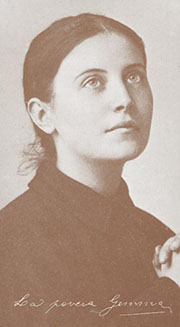
Saint Gemma Galgani
In fact, the saints teach us that suffering is of such great merit, that it is greater than external works such as preaching, writing, or even working miracles; "You will save more souls through prayer and suffering than will a missionary through his teachings and sermons alone." (Jesus to Saint Faustina). To illustrate this point, a demon once lamented to Saint John Vianney that hell had lost 80,000 souls due to his prayers and sacrifices alone. Saint Vianney did not need to travel the world and preach. He was a simple parish priest of a remote village. And yet, he was able to save 80,000 souls through a solitary life of prayer and sacrifice.
An Objection: "But how can this be so? How can a God of love value our suffering? After all, suffering exists because of sin." Yes, it is true. Suffering entered the world through the disobedience of our first parents. So, clearly, God never intended for us to suffer. Even while on earth, Jesus worked miracles of healing for countless people, curing blindness, leprosy, deformities, and disease. There is no doubt. Our Lord wants us happy and healthy, and not to suffer. But it is when we offer our suffering--the one thing most disagreeable to our human nature--back to the Creator, it becomes a gift of inestimable value; drawing down from heaven more grace than any other action we can possibly make.
In other words, "We love only to the degree that we are willing to suffer." (Fr. John Hardon, S.J.) Instinctively we know this to be true. After all, if someone preaches to me with great zeal, I will not be as convinced of their love, as when that same person suffers and undergoes hardship for my sake. Similarly, the defining moment of redemption for humanity was not when Our Lord preached in the synagogues or healed the sick. It was when Love was nailed to a tree and drained of His blood. In a certain sense, love and suffering are inseparable; for love is proven through suffering and suffering is perfected through love. And what greater proof of love is there than the one who dies to save His very executioners? Nowhere in the history of humanity has such love been taught, let alone entered into the thought of man. And it is precisely this kind of suffering, that we as Christians are called imitate, to willingly forget self in order to make others happy. Thus we see the end of suffering, not for its own sake, but for the life it breathes into souls through active love.
God to St. Catherine of Siena: "Daughter, this is what I want: That you seek to please me by you deep hunger and concern for the salvation of souls. But neither you nor anyone else can achieve this without accepting whatever sufferings I grant."

The Meaning of Love
This brings us to our next consideration. What does it mean to love? And how does one attain it? Let us first recall that every action of God is governed by love, because God IS love itself (1 John 4:8). It is His nature to love. He therefore cannot do anything but love. This, after all, is what most distinguishes Christianity from other religions. Christianity is the religion of radical love; love in its highest form; not a warm fuzzy feeling, but a manly love; a love that is willing to be trampled upon, to be dragged face-down in the dust so others can be saved. This kind of Love entered our world as a baby, and walked this earth long ago, so mankind could learn how to live in response. And the only true and proper response to love, is love. This is the primordial choice every person is faced with in this life; to choose Love, or to reject Love.Saint Catherine of Siena: “The soul cannot live without love. She always wants to love something because love is the stuff she is made of, and through love I created her. [...] That is why I have put you among your neighbors: so that you can do for them what you cannot do for me--that is, love them without any concern for thanks and without looking for any profit for yourself.”
But what does it mean to love? How do we live it out in daily life? Let us first begin with the question: What is love. As we know, love is a theological virtue, which means that man cannot attain it on his own. It is a shear grace from heaven. Saint Thomas Aquinas calls it charity, and describes it as the "chief" of all the virtues, because it is the umbrella under which all virtue and every gift is born and sustained. From it flows every gift, grace, and heavenly aid. Love is, in short, the goal and purpose of every action in every moment of our lives. But what does this mean practically? How does one love in daily life? One definition which the Church has used to define love is; "to will the good of the other, as other." In other words, love is primarily an act of the will, which, as pope John Paul II notes, sees the other as a good in itself rather than an object to be used as a means to an end. Said another way, love is total self-gift, a giving of oneself to others without expecting anything in return. In its highest form, love is not only sacrificial, but it is also spousal love. To put it plainly, love is totally other-centered; it takes no account of cost to self. To love totally, means to be totally forgetful of one's own needs, and to be constantly in search of doing all that is beneficial for the other's soul, "to will the good of the other," that is; to will God, Who is Goodness itself, for the other. This is how we are to live: To govern our actions so as to spur others to the love of God.
Catechism of the Council of Trent, preface 10: "The whole concern of doctrine and its teaching must be directed to love...all the works of perfect Christian virtue spring from love, and have no other objective than to arrive at love."
An Objection: "But if you always give and give, then you will get burnt out. Surely there are limits to how much we should give of ourselves. After all, we are only human, and need to take some time for ourselves." This objection warrants some attention, since it seems to be common in our modern sensible worldview today (even in religious life). And although such sensible advice may be given with good intentions, Saint Faustina says the devil often comes under the guise of sensible advice (hink of Peter's advice to Our Lord, which He had to chastise "Get behind me Satan!"). Why is such advice dangerous? Because hidden within it lies a kernel of egoism, which can grow unchecked if we are not careful. But what is more, no where in the Gospel does such advice enter. Rather, it is precisely the opposite that Christ teaches us; that the more we give ourselves away, the more we receive in return, and likewise the easier it becomes to love. Love frees the soul, giving it wings to fly.
Saint Catherine of Siena: “Those who are willing to lose their own consolation for their neighbors' welfare receive and gain me and their neighbors...and so they enjoy the graciousness of my charity at all times."
The trap, however, that many fall into, is in reducing the notion of "self-gift" to merely external works, such as social justice for example. As a result, such people do get burnt out over time; for one cannot give what one does not have. People too often rely on their own strength, running from one activity to the next, and neglect prayer--the one wellspring of infinite grace, vitality, and strength. We forget that Christ Himself, our model, often spent entire nights in prayer, so that He can be first filled with the love of the Father before going back out into the world. The foundation of prayer is therefore essential to love, for we cannot make a supernatural gift of ourselves unless we first possess what is supernatural.
This point must be emphatically stated. If we want love, we must pray. We simply cannot love with supernatural charity until we first make it our practice to learn from the Master, Love itself, by kneeling at His feet in humble adoration. If one acts in this way, then love becomes easy. Self-gift becomes easy, and self-immolation a joy. Rather than getting burnt out over time, love invigorated, wanting to give more and more of itself. The only pain the soul experiences, says Catherine of Siena, is the pain of the offense done to God and the harm done to souls, the self-inflicted wounds of sinners--for as Thomas Aquinas reminds us, "sin is its own punishment." In fact, this is the surest sign that one loves totally: when the soul finds herself (we speak of the soul in the feminine because that is what the saints have done) searching out precisely those most difficult to love, those who others avoid, the downcast and the needy. For love is not content to remain in comfort among friends, but desires to pour itself out on those "most in need of God's mercy." Suffering then becomes easy for the one who loves. In fact, Catherine of Siena says that the holier one becomes, the less they suffer!
"Wait. The holier one is, the less they suffer? What about Mother Teresa?"
Yes. As a general rule, this is true. As Saint Catherine confirms;"the more they have scorned pleasure and been willing to suffer, the more they have lost suffering and gained pleasure." Why? Because as God tells her,"I will never withdraw from their feelings. No, their spirits always feel my presence within them, whereas regarding others I come and go...In other words, they can join their spirits with me in loving affection whenever they will...Every time and place is for them a time and place of prayer."
This seems to contradict conventional wisdom, which sees the Mother Teresa's of the world and concludes that the holier one is, the more in darkness and dryness they experience. This is a dangerous misunderstanding of the Dark Night (which, after all, is only a temporary state), one which causes an irrational fear of holiness. It is important to stress that Mother Teresa had a very unique calling, and not every saint is called to be a victim soul. Let us remember that God is a good and loving Father, and will not give us more than we can handle. He wants us to be beacons of light for others, to draw souls to God. And to do this, we need to be filled with love, joy, and peace, so that we may give love, joy, and peace to others (are not these three fruits of the Holy Spirit after all?).
"My mind is so full of joy and happiness that I am amazed my soul stays in my body." - Saint Catherine of Siena
The joy and peace that God gives is so profound, says Saint Catherine, that the soul cannot help but weep in prayer. In fact, weeping is so common among holy religious, that Saint Catherine devoted an entire chapter on this subject alone. According to her, there are four stages of tears. In the 4th stage, "She begins to feel joy and compassion: joy for herself because of this impulse of love, and compassion for her neighbors. Then her eyes, which want to satisfy her heart, weep in charity for me and her neighbors with heartfelt love, grieving only for the offense done to me and the harm done to her neighbors." This is not to say, however, that the saints do not experience trial and hardship. Quite the contrary. But the trial and hardship will be of no account to them, and will become occasions of growth and great fruit due to the patience with which it was borne, just as the Apostles rejoiced in all their trials and persecutions (Acts 5:41, 14:21, Rom 8:18, 2 Corinthians 12:10, etc.). Let us be assured, then, that holiness is not something to fear, but rather, something to be sought after with great diligence; for no one on this earth is more happy, joyful, and content than a holy religious. And no one is so gently offered the choice, if they accept, to be swept to the heights of love by accepting the chalice offered to them,
"He has offered this chalice to me yet again, and I have accepted it. That is why He does not spare me." - Padre Pio
The Highest Suffering: Redemptive
When one prays, one is able to love supernaturally. And when one loves, one is able to bear all things joyfully for love of Christ, just as the Apostles did. And in so doing, we participate in God's plan of salvation so intimately that we become little "co-redeemers", as it were, and obtain conversion of souls. As God told Saint Faustina, it is as if His hands are bound by the creature who loves. Even one small act of love is enough to open heaven and cause a torrent of grace to pour forth upon the world. As Our Lady told the world at Fatima; "Many souls go to hell because there is no one to sacrifice themselves and pray for them." This is what it means to share in a "common priesthood" of Christ. While priests of the Old Testament sacrificed animals to atone for sin, Christ became the Sacrifice par excellence to atone for all sin. And in like manner, the servant must follow the master. We too therefore must offer ourselves upon the altar of the cross, patterned after our Model and Savior--but not in a morbid way. Rather, it is in offering daily small sacrifices with joy, and accepting with resignation the Divine will in all things, that the infinite wellsprings of grace pour forth. Such prayer enables one to elevate suffering beyond the natural, to a supernatural end, becoming a means of inestimable value.Saint Catherine of Siena: "...every suffering they bear from any source at all, in spirit or in body, is of infinite worth, and so satisfies for the offense that deserved an infinite penalty...[even though]...these are finite deeds in finite time. [...] Then she must love her neighbors with such affection that she would bear any pain of torment to win them the life of grace, ready to die a thousand deaths, if that were possible, for their salvation.”"
Servant of God, Fr. John Hardon: "Love wants to suffer for the Beloved... Love wants to expiate the sins that have so deeply penetrated mankind. Love wants to make up for the lack of love among those who sin. Love wants to relieve the debt of suffering that sinners owe to God. Love wants to give God what sinners are depriving Him of by their sins."
Saint Therese of Lisieux: "I understood that to become a saint one had to suffer much, seek out always the most perfect thing to do, and forget self. I understood, too, that there are many degrees of perfection and each soul was free to respond to the advances of the Our Lord, to do little or much for Him, in a word, to choose among the sacrifices He was asking. Then, as in the days of my childhood, I cried out: 'My God I choose all!' I do not want to be a saint by halves. I'm not afraid to suffer for You. I fear only one thing: to keep my own will; so take it, for I choose all that You will!"
Ven. Mary of Agreda: Words of the Queen: "I remind thee that there is no exercise more profitable and useful to the soul than to suffer....Therefore, my daughter, embrace the cross, and do not admit any consolation outside of it in this mortal life. By contemplating and feeling within thyself the sacred Passion, thou wilt attain the summit of perfection and attain the love of a spouse...I find so few who console with me and try to console my Son in His sorrows..."
Diary of Saint Faustina: "Jesus says; 'My daughter, I want to instruct you on how you are to rescue souls through sacrifice and prayer. You will save more souls through prayer and suffering than will a missionary through his teachings and sermons alone. I want to see you as a sacrifice of living love, which only then carries weight before Me... And great will be your power for whomever you intercede. Outwardly, your sacrifice must look like this: silent, hidden, permeated with love, imbued with prayer."
....More Saints Quotes
Saint Therese, Joy In Suffering, pg.8: "Never does our suffering make Him happy, but it is necessary for us, and so He sends it to us, while, as it were, turning away His face.... I assure you that it costs Him dearly to fill us with bitterness. The good God, who so loves us, has pain enough in being obliged to leave us on earth to fulfill our time of trial, without our constantly telling Him of our discomfort; we must appear not to notice it...Far from complaining to Our Lord of the cross which He sends us, I cannot fathom the infinite love which has led Him to treat us this way...What a favor from Jesus, and how He must love us to send us so great a sorrow! Eternity will not be long enough to bless Him for it."
Saint Gemma Galgani, letters
Jesus spoke these words; "My child, I have need of victims, and strong victims, who by their sufferings, tribulations, and difficulties, make amends for sinners and for their ingratitude."Saint Teresa of the Andes, on Religious Life, (age 15), Letters p.121
"Her sacrifice is perpetual, without mitigation, from the time her religious life begins until she dies as a victim according to the example of Jesus Christ. And she does all this in silence with no one aware of it. Yet how many are there who think of this life as useless. Nevertheless, she (the religious) is like the Lamb of God. She removes sins from the world. She sacrifices herself to bring back to the sheepfold those sheep who have gone astray. But just as Christ did not know the world, neither does she know it. This abnegation enchants me completely. There is no room for self-love. She doesn't even see the fruit of her prayer. In heaven alone will she know this."Padre Pio, Secrets of a Soul, p.47
"Jesus said to me; 'How many times would you have abandoned Me, my son, if I had not crucified you. Beneath the cross, one learns love, and I do not give this to everyone, but only to those souls who are dearest to Me."

Prayer Obtains Love.
As we have said above, prayer is the first step, the foundation upon which love is built. If love is the goal, then prayer is the means (and sacrifice is the support to prayer). Without prayer, without an intimate closeness to God, one cannot love supernaturally. And without supernatural love, one will accomplish very little in this life, and be converted with difficulty. Love, after all is a theological virtue (the "chief" virtue, according to Aquinas), and therefore a shear grace from God. The only way to attain it, is by humbly acknolwedging that we are nothing of ourselves, and like a little child, keep the gaze of our mind and the desires of our hearts fixed on God in all that we do---to, in short, "pray ceaselessly" as the Scriptures tell us. As we have talked about elsewhere, prayer must be "constant and humble," according to Saint Catherine of Siena, in order to be efficacious. In other words, without humility and without regularity, our hearts will be closed to grace. And without grace, love is not possible, nor will suffering be given any redemptive value. Put simply, pray as a saint, and you will love as a saint.
The Purgative, Unitive, and Redemptive qualities of Suffering?
Now let us begin to parse the distinct fruits of suffering. As we have said, the highest form of suffering is redemptive. But suffering also bears other fruits as well, both for ourselves and for others. The following are three distinct fruits of suffering;
1. Purgative. Suffering acts to purify and humble the soul. It is a crucible in which the impurities and worldly attachments are unmasked and expelled. Suffering can be physical (such as illnesses), emotional (humiliation, persecution, etc.), or spiritual (dryness in prayer, temptations, etc.). It can also be passive (imposed on us, beyond our control), or active (through penitential practices such as fasting or small acts of self-denial). This purgative trait of suffering [n.b., Purgative Way] is the first and most necessary step toward union with Our Lord, because it helps divest from the soul the "old man"; pride, avarice, lust, and worldly attachments. And like a good mother who is quick to shower her child with kisses for a good effort, so too is God quick to shower the soul with consolations and sweetness in prayer. The more faith and trust the soul has, the more it will be compensated and be given supernatural value. Saint John of the Cross believed that this stage was so necessary, that without a complete and total eradication of the appetites and self-will, a soul will never advance to higher degrees of holiness. As he states; "One inordinate appetite alone....suffices to make the soul so captive, dirty, and unsightly, that until the appetite is purified, the soul is incapable of conformity with God in union." And again he writes; "It makes little difference whether a bird is tied down by a thread or by a chain. The bird will be held down just the same."
Saint Faustina: "O my Jesus, I know that, in order to be useful to souls, one has to strive for the closest possible union with You, who are Eternal Love... I can be wholly useful to the Church by my personal sanctity, which throbs with life in the whole Church, for we all make up one organism in Jesus."
Saint Catherine of Siena: "You cannot arrive at virtue except through knowing yourself and knowing me. And this knowledge is more perfectly gained in time of temptation, because then you know that your are nothing, since you have no power to relieve yourself of the sufferings and troubles you would like to escape....for the devil is weak and can do nothing of himself, but only as I permit him. And I give him leave not through hatred but through love, not so that you may be conquered but that you may conquer and come to perfect knowledge of yourself and of me, and to prove your virtue--for virtue can only be tested by its opposite."
2. Unitive. Once metal has been sufficiently purified in the crucible, it can then be forged into a proper instrument to be wielded by the hands of the Welder. This second quality is a natural consequence of the first, in that the purification enables the soul to be united to God. The voids that are created in the fire of purification can now be filled with grace and sealed with virtue. In this stage, the soul begins to realize what it once thought was love, was only an imperfect affection. It is now beginning to understand what true love consists; not in consolations alone, not in transports of the spirit, nor great works, or ecstasies, but in loving; in spending oneself for others; in giving until it hurts, without expecting any recompense. It is now discovering the true "secret to happiness" that so many self-help books attempt to answer; what men have searched the globe to find. It is a great mystery that has eluded many, and yet it is a profoundly simple truth in Christianity, that; man can only find himself by giving himself away. As Vatican II reminds us; "Man cannot find himself except by making a sincere gift of himself" The gaze of his entire being must turn away from himself completely, and only toward God and His children in total self-gift. As Saint Therese of Lisieux once said; "I never made more progress in the spiritual life, as when I began to devote myself to praying for others." And so, in this stage, the soul is now "finding itself"; it is becoming more what it was created to be before the fall ("original man"), and its happiness increases beyond its imaginings. Just as the force of a magnet increases as it draws nearer to iron, so too does the union between God and the soul increase in like. But now, the soul is still not yet perfect. And so Our Lord may ask (but does not force) the soul to continue its advance. If the soul complies, she may begin to experience periods of interior darkness, or nights, where she must learn become detached not only from creatures and things of this earth, but also spiritual attachments as well; at times feeling as if a blind man walking in darkness, relying on only blind faith and obedience as its guide. It is during these periods that the soul makes the greatest progress, unbeknownst to itself. And once the darkness passes, the soul looks back and sees the great chasm it crossed, utterly overwhelmed and inflamed with love.
Saint Faustina: Sufferings, adversities, humiliations, failures and suspicions that have come my way are splinters that keep alive the fire of my love for You, O Jesus."
3. Redemptive. The third quality of suffering is the highest form of suffering, because it is directed entirely outward toward the salvation of souls. Redemptive suffering most intimately configures us to Christ, Who entered this world for this very purpose. It is the culminating work of Christ, and thus there is nothing greater that we can do in our imitation of Him. It is the kind of suffering that cries to heaven for humanity;"Forgive them!", and searches for reasons to excuse man; "For they know not what they do!" It sheds copious tears not only for mankind, but especially for those who suffer, and for hardened sinners; "those in most need of God's mercy." Redemptive suffering is offering oneself as a holocaust; to suffer the very fires of hell in order for others to obtain heaven. It takes on the sins of others, acting as a kind of sponge absorbing the evil around. This form of suffering is so powerful--because love is so powerful--that its arms can span the entire world and can the alter the course of history.
And yet, redemptive suffering does not have to take on extreme forms as we might expect. But rather, any suffering, if offered with love, can have redemptive value, even something as mundane as a toothache. As Saint Therese reminds us, the smallest act of pure love is greater than the greatest miracles and feats of human strength, and can merit the conversion of souls. How is this possible? How can the prayers of a single person alter the lives of people on the other side of the world? How did Saint Faustina save 1,000 souls in just 40 days by her sacrifices and prayers behind the walls of a cloister? As we have learned by now, love knows no bounds; love is not limited by time or space. Although man is a finite being, he is capable of making an infinite gift to God through love (Catherine of Siena).Saint Faustina
"On the First Friday of the month, before Communion, I saw a large ciborium filled with sacred hosts. A hand placed the ciborium in front of me, and I took it in my hands. There were a thousand living hosts inside. Then I heard a voice, These are hosts which have been received by the souls for whom you have obtained the grace of true conversion during this Lent." (Diary, p640)Saint Teresa of the Andes
"We [religious] are co-redeemers of the world. And souls are not redeemed without the cross."Saint Catherine of Siena
"Never cease offering me the incense of fragrant prayers for the salvation of souls, for I want to be merciful to the world. With your prayers and sweat and tears I will wash the face of my bride, holy Church."
In a vision given to Saint Faustina, we observe that it is the daily sacrifices made by religious communities that sustain the world in existence, acting as a shield blunting the sword of God's justice upon the world;
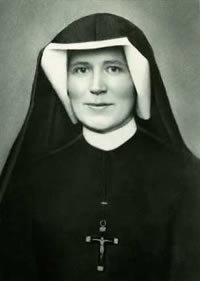
Saint Faustina"During the renewal of the vows, I saw the Lord Jesus on the Epistle side (of the altar), wearing a white garment with a golden belt and holding a terrible sword in His hand. This lasted until the moment when the sisters began to renew their vows. Then I saw a resplendence beyond compare and, in front of this brilliance, a white cloud in the shape of a scale. Then Jesus approached and put the sword on one side of the scale, and it fell heavily towards the ground until it was about to touch it. Just then the sisters finished renewing their vows. Then I saw Angels who took something from each of the sisters and placed it in a golden vessel on the other side of the scale, it immediately out weighed and raised up the side on which the sword had been laid. At that moment, a flame issued forth from the thurible, and it reached all the way to the brilliance. Then I heard a voice coming from the brilliance: "Put the sword back in its place; the sacrifice is greater."
No words can describe the image this vision paints. And what makes the sacrifice of religious life so great? Again, "humble, constant prayer." This is the most distinguishing feature of a thriving community. If it's prayer is humble, then one has found a gem to behold. Is such a gem not worth diligently searching for in one's discernment? As Our Lady revealed to Venerable Mary of Agreda, if the saints in heaven were able to feel regret, they would lament over not making better use of their time on earth. Let us then take advantage of this great gift of life, recalling the profound love Our Lord has for us. All He asks of us is our love, and if we are willing, a little sacrifice. Such a small price for such indescribable rewards!
Jesus to Saint Faustina: "For the sake of your love, I withhold the just chastisements, which mankind has deserved. A single act of pure love pleases Me more than a thousand imperfect prayers. One of your sighs of love atones for many offenses with which the godless overwhelm Me. The smallest act of virtue has unlimited value in My eyes because of your great love for Me. In a soul that lives on My love alone, I reign as in heaven. I watch over it day and night. In it I find My happiness; My ear is attentive to each request of its heart; often I anticipate its requests. O child, especially beloved by Me, apple of My eye, rest a moment near My Heart and taste of the love in which you will delight for all eternity. But child, you are not yet in your homeland; so go, fortified by My grace, and fight for My kingdom in human souls; fight as a king's child would; and remember that the days of your exile will pass quickly, and with them the possibility of earning merit for heaven. I expect from you, My child, a great number of souls who will glorify My mercy for all eternity. My child, that you may answer My call worthily, receive Me daily in Holy Communion. It will give you strength'..."
....More Saints Quotes
Saint Catherine of Siena, The Dialogue:
"It is the way of wicked sinners, and I beg you to pray to me for them. I ask for your tears and sweat on their behalf so that they may receive mercy from me."Mary of Agreda, Mystical City of God, Book VI, Chp. IV
Words of the Queen: "If my lord and master has made Himself the life and the way for men though his Passion and Death, is it not evident that in order to go that way and live up to this truth, they must follow Christ crucified, afflicted, scourged and affronted? Consider the ignorance of men who wish to come to the Father without following Christ, since they expect to reign with God without suffering or imitating his Passion, yea without even a thought of accepting any part of his suffering and Death, or of thanking Him for it. They want it to procure for them the pleasures of this life as well as of eternal life, while Christ their Creator has suffered the most bitter pains and torments in order to enter heaven and to show them by His example how they are to fight the way of light."...but they [mankind] make their recovery impossible, since all of them are weak and afflicted by many sins, for which the only remedy is suffering...tribulation earns the pardon of the just Judge. By the bitterness of sorrow and affliction the vapors of sin are allayed; the excesses of the concupisible and irascible passions are crushed; pride and haughtiness are humiliated; the flesh is subdued; the inclination to evil, to the sensible, and to earthly creatures is repressed; the judgment is cleared; the will is brought within bounds and its desultory movements at the call of the passions, are corrected; and above all, divine love and pity are drawn down upon the afflicted, who embrace suffering with patience, or who seek to imitate my most holy Son. In this science of suffering are renewed all the blessed riches of the creatures; those that fly from them are insane, those that know nothing of this science are foolish."
What if I am afraid of suffering?
When we think of suffering, many are tempted to think only of only the more extreme forms; hospital beds, terminal illnesses, or perhaps even torture and martyrdom. Others might think of victim souls such as Mother Teresa or Saint Faustina, who had to suffer through much darkness and dryness in prayer. If this is our idea of holiness, then it is no wonder why some are afraid of advancing---if this is what we have to look forward to!
As we have said above, suffering does not have to take on these more extreme forms. Anyone can offer little sacrifices each day, and become holy by doing so. Remember, God is a loving and gentle God, and He wants us to be happy. He will only permit someone to become a victim soul if that soul is especially called to such a life and firmly resolved to that end. (The soul is free to choose its path, since God has given us the gift of free will, and honors that gift assiduously). Our crown in heaven will radiate to the degree that we loved on earth, and suffering adds further gems to our crowns, whether it be short periods of intense suffering or spread out thinly over time. Every day presents a thousand opportunities to offer oneself as a gift to God and others; even in something as simple as a broken toe-nail, being accused unjustly, or being asked for help at an inconvenient time. How we respond in such instances, can have profound hidden effects on the world and the radiance of our own souls. In fact, these little daily opportunities can be more efficacious than if we offered our necks to the guillotine as martyrs. For, to persevere day-in and day-out in a thousand small victories requires a greater act of the will than a single moment of heroic virtue supported by grace. We become, as it were, slow burning embers, continually offering incense before the throne of God. As Our Lady told Venerable Mary of Agreda; "For I assure thee, my dearest, that those who are perfect and punctual in their religious obligations can equal and even surpass the martyrs in merit." This same sentiment is echoed by Saint Therese; "There are trifles that please Our Lord more than the conquest of the world; a smile or a kindly word, for instance, when I feel inclined to say nothing or to appear bored."If one is still afraid of suffering, it may be comforting to know that you are not alone, since even the saints had to grow in their love;
Diary of Saint Faustina
"At the beginning of my religious life, suffering and adversities frightened and disheartened me. So I prayed continuously, asking Jesus to strengthen me and to grant me the power of His Holy Spirit that I might carry out His holy will in all things, because from the beginning I have been aware of my weakness." [p. 56] She later writes; "From the moment I came to love suffering, it ceased to be a suffering for me. Suffering is the daily food of my soul.""Do not be afflicted if your heart often experiences repugnance and dislike for sacrifice. All its power rests in the will, and so these contrary feelings, far from lowering the value of the sacrifice in My eyes, will enhance it. Know that your body and soul will often be in the midst of fire. Although you will not feel My presence on some occasions, I will always be with you. Do not fear; My grace will be with you...[...] "O my Jesus, farewell; I must go already to take up my tasks. But I will prove my love for You with sacrifice, neither neglecting nor letting any chance for practicing it slip by.
"Once, when I was in the kitchen with Sister N., she got a little upset with me and, as a punishment, ordered me to sit on the table while she herself continued to work hard, cleansing and scrubbing. And while I was sitting there, the sisters came along and were astounded to find me sitting on the table, and each one had her say. One said that I was a loafer and another, "What an eccentric!" I was a postulant at the time. Others said, "What kind of of a sister will she make?" Still, I could not get down because sister had ordered me to sit there by virtue of obedience until she told me to get down. Truly, God alone knows how many acts of self denial it took. I thought I'd die of shame. God often allowed such things for the sake of my inner formation, but He compensated me for this humiliation by a great consolation. During Benediction I saw Him in great beauty. Jesus looked at me kindly and said, 'My daughter, do not be afraid of sufferings; I am with you.'"
Distrust Wounds Our Lord
In sufferings, the soul must trust that it is in God's care, and that nothing will harm it--for God's goodness will never give a soul more than it can bear, or more than it permits to bear. Our trust in His goodness must be unerring and absolute;
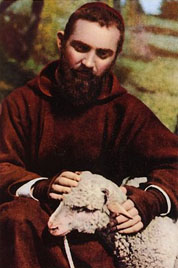
Padre PioSaint Faustina
"Your great trust in Me forces me to continuously grant you graces. You have great and incomprehensible rights over My Heart, for you are a daughter of complete trust."Saint Faustina
"[Jesus says;] Distrust on the part of souls is tearing at My insides. The distrust of a chosen soul causes Me even greater pain; despite My inexhaustible love for them they do not trust Me. Even My death is not enough for them. Woe to the soul that abuses these gifts."Padre Pio
"O what precious moments these are. It is a happiness that the Lord gives me to relish almost always in moments of affliction. At these moments, more than ever, when the whole world troubles and weighs on me, I desire nothing other than to love and to suffer. Yes my father, even in the midst of so much suffering I am happy because it seems as if my heart is beating with Jesus' heart."
To Court the Cross
If suffering is the greatest form of love, then meditation on Our Lord's passion is the greatest form of meditation. As Jesus told Saint Faustina once; "There is more merit to one hour of meditation on My sorrowful Passion than there is to a whole year of flagellation that draws blood; the contemplation of My painful wounds is of great profit to you, and it brings Me great joy." A soul that always has Our Lord's Passion and Our Lady's agony on the forefront of her mind will make rapid progress in the spiritual life, for it is through the passion of Our Lord that God's love for man is revealed in its highest form. We read similar sentiments in a vision given to Saint Faustina, during a time when she had great dryness of prayer;
Diary, October 11, 1933 : "Jesus was suddenly standing before me, stripped of His clothes, His body completely covered with wounds, His eyes flooded with tears and blood, His face disfigured and covered with spittle. The Lord then said to me, "The bride must resemble her Betrothed." I understood these words to the very depth. There is no room for doubt here. My likeness to Jesus must be through suffering and humility. "See what love of human souls has done to Me. My daughter, in your heart I find everything that so great a number of souls refuses Me. Your heart is My repose. I often wait with great graces until towards the end of prayer."
Padre Pio, Secrets of a Soul: "When Jesus wants me to understand that He loves me, He allows me to savor the wounds, the thorns, the agonies of His passion...When He wants to delight me, He fills my heart with that spirit which is all fire; He speaks to me of His delights. But when He wants to be delighted, He speaks to me of His sorrows, He invites me -- with a voice full of both supplication and authority -- to affix my body [to the cross] in order to alleviate His suffering. Who can resist Him? I realize how much my miseries have caused Him to suffer, how much I have offended Him. I desire no other than Jesus alone, I want nothing more than His pains (because this is what Jesus wishes). Let me say--since no one can hear me--I am disposed to remain forever deprived of the sweetness Jesus allows me to feel. I am ready to suffer Jesus hiding His beautiful eyes from me, so long as He does not hide His love from me, because then I would die. But I do not feel I can be deprived of suffering--for this I lack strength. [...] Perhaps I have not yet expressed myself clearly with regards to the secret of this suffering. Jesus, the Man of Sorrows, wants all Christians to imitate Him; He has offered this chalice to me yet again, and I have accepted it. That is why He does not spare me. My humble sufferings are worth nothing, but Jesus delights in them because He loved [suffering] on earth...Now shouldn't this alone be enough to humiliate me, to make me seek to be hidden from the eyes of men, since I was made worthy of suffering with Jesus and as Jesus? Ah, my father! I feel too keenly my ingratitude toward God's majesty."
 |
SOURCES:
Davide A. Bianchini, Contact