Ten Guidelines on Finding The Ideal Community
It is important to emphasize that choosing a community ought to be less about externals, and more about the holiness of its members. More important than checking boxes in a checklist---such as "they are strong in sacred music," "they minister to the elderly," "they have a charism in..." and so on---is whether the community will aid and support the soul in her spiritual progress. This begins first by having examples of holiness to inspire to (recalling to mind they will be living the rest of their lives together). To a well formed Catholic, recognizing holiness where it exists should not be difficult: We are not speaking of gifted learning, or long hours of pious prayer, or laughter and having fun--which anyone can do. Rather, holiness is best discovered in smaller nuances, in how its members treat each other, in their simplicity and humility, in their docility and good-nature, in speaking well of others and in self-deprecation, and the like. To make it easier to discover signs of holiness, we put together the following list of additional indications that may point to a holy community (Note, for convenience, we might refer to religious as feminine, with the pronoun "she." But we also include male communities as well.)

| 1. |
How Often Do They Speak of God?
From the mouth follow the desires of the heart. It is a good sign that religious speak often of God; for this indicates their hearts are occupied with the very reason of their vocation. When Saint Teresa of the Andes was discerning her vocation, she preferred the convent in the Andes over a different convent for this reason; "I noticed that the Sister at the turn asked me about all kinds of worldly things that I didn't like...On the other hand, at Los Andes, we spoke only about God and just mentioned a few people to recommend them to God in our prayers...Their presence and conversation has deepened my recollection and brought me great peace." Although Padre Pio spoke little during recreation, he was also known for telling a funny story on occassion, or having a witty remark. And yet his jokes always contained a spiritual lesson in them. Thus even humor can be used to edify one's companions---a necessary charity in religious life. As Saint Alphonsus Ligouri says, "Religious can expect to die more contented, assisted by their holy companions, who continually speak of God; who pray for them, and console and encourage them in their passage to eternity..." Indeed, our words carry great influence over those around us, and holy souls will love their companions enough to choose words their words carefully (which sometimes also means remainig silent, in order to avoid the spirit of dissipation). As Saint Faustina says; "I tremble to think that I have to give an account of my tongue. There is life, but there is also death in the tongue." Indeed, just as edifying words can help sanctify those around us, so too can our careless words lead others astray. Thus, it dangerous to believe one can reform a community from the inside. As Pope John Paul II once said; "you end up resembling the company you keep". Why then, should we not seek out a community that is so captured by the love of God that it is reflected in their words--words which in turn support us and spur our souls closer to God? Is this not a prime advantage of religious life?
Padre Pio:"I acknowledge having reached a very great desire to deal with people who have made progress on the path to perfection. I love them very much because it seems to me that they assist me greatly in loving God. [...] It gives me great pain to deal with others, except those people with whom one speaks of God and of the preciousness of the soul. This is why I love solitude so much."
Saint Alphonsus De Ligouri: The mere "good examples of her saintly companions" will help raise the religious to the heights of sanctity and "remind her continually of the transgressions into which she has fallen."
....more quotes
Saint Teresa of Avila: "The sisters should pay no attention to the affairs of the world, nor should they speak about them." We note here section 2d of the Vatican II document Perfectae Caritatis, which states; "Institutes should promote among their members an adequate knowledge of the social conditions of the times they live in and of the needs of the Church...to assist men more effectively." This directive of Vatican II suggests that while worldly conversation is discouraged, in these present times, the Council desires religious to be somewhat aware of the needs of the Church in the world.Saint Alphonsus De Ligouri: "[Religious] must not speak of things of the world; such as marriages, feasts, comedies, or of splendid dresses: they must not speak of eating, nor praise or censure the dishes that are brought to table... When religious hear unseemly discourses, they should, like St. Aloysius, propose some useful question, or take occasion from what is said to introduce some pious subject of conversation."
2. Does Concern for Souls and Helping Others Occupy Their Time?
Speaking about God would not be complete if it did not end in our neighbor; for our love for God is only as great as our love for our neighbor. (1 Jn 4:20) This is especially so for religious, whose very life is ordered toward neighbor, especially toward the salvation of souls. As God told Saint Mary Magdelene de Pazzi, "See...how [they] are in the hands of the devil. Unless my elect deliver them by their prayers, they shall be devoured." It is for this reason that she exhorted her sisters, "My sisters, God has not separated us from the world for our own good alone, but also for the benefit of sinners." Indeed, religious have a great responsibility. The graces, consolations, and constant enjoyment of God's presence is not for her sake alone, but so she might pass those graces onto others. When God appeared to Saint Catherine of Siena, He implored her, "I beg you to pray to me for sinners. I ask for your tears and sweat on their behalf so that they may receive mercy from me." It is widely accepted among the saints that a clear sign of holiness--next to humility--is a deep longing for the salvation of souls. Should this not also be a trait of a holy community as well, if the members are not only humble, but also are occupied with the thought of helping others, both spiritually and materially, both within and outside the walls of the community? Do we love God enough to do what He desires, to help Him with our prayers and sacrifices? For the religious, let us hope the answer is yes; for if she is serious about her mission to sanctify the world, then her thoughts ought to continually return to this refrain, "Spare, O Lord, Thy People!" (Joel 2:17) And as we pray in the Fatima prayer during the Rosary, "especially those in most need of Thy mercy!" Indeed, true love is not selfish with the Beloved, but desires to help in any small way it can. It cherishes what God cherishes, and grieves over what grieves God. When Our Lord was hanging on the cross, says Mary of Agreda, His greatest suffering was not the physical pain of the crucifixion, or even the spiritual loss of the Father's presence, but rather, knowing how so few would benefit from His sacrifice. There is nothing that pains God more than the loss of souls. This should be the greatest sorrow of religous as well.
But let us be clear: Love should not only be general, but also particular. In other words, a religious must not love souls in only an abstract universal sense (though this is the height of her calling), but also a particular sense; the souls in front of her, the souls of her companions. In fact, the degree to which she saves all souls, will depend on the degree to which she saves the few in her community. Why? Because her sisters are those she sees (Jn 4:20), the ones she can practice charity with. Dorothy Day once said that we only love God to the degree that we love the person we find most difficult to love. This this therefore a good test of the holiness of a religious. If she says she loves God and prays for the salvation of souls, but does not reach out to an unpopular and ignored sister, or if she fails to correct a sister who complains or is harming their soul in some other way, then her holiness is in question. The salvation of souls, in other words, depend first upon how she treats those in her immediate sphere. The more religious love and support one another in their community, the easier it will be for them to love and support all souls on earth, because God will see their efforts and hear their prayers.
God to Saint Catherine of Siena: "This is why I have put you among your neighbors: So you can do for them what you cannot do for me, that is; love them without any concern for thanks and without looking for any profit for yourself."
Saint Teresa of Avila was known to do many small acts of charity for her sisters throughout the day, even in the smallest things like holding her lamp up at night to give light to a sister walking by her cell in the dark. The smallest act of love can carry great weight before heaven, and her prayers will be heard as a result.God to Saint Catherine of Siena, "Never lower your voice in crying out to me to be merciful to the world....This is what I require of my servants and this will be a sign to me that you love me in truth."
3.
Does The Spirit of Love and Joy Reign Among Them?
In 1938, Our Lord lamented to Saint Faustina that "Love has been banished from communities...I called convents into being to sanctify the world through them. It is from them that a powerful flame of love and sacrifice should burst forth". Our Lord desires a deep passionate love from the heart of every religious, to the extent that they become like angels, "walking with only one foot on the earth." Saint Teresa of the Andes once described her sisters as angels clothed in human flesh, and admired their joy; "I love their simplicity and joy, as well as the familiarity that reigns among them." Indeed, when visiting a religious community, one should feel like they are entering a very loving family. Saint Alphonsus De Ligouri says that religious address themselves as brother and sister "because they are such not by blood, but by charity, which should unite them in love more closely than all the ties of flesh and blood." Certainly, no one more worthy of the greatest graces and consolations than a good religious who daily makes efforts to renew their love. Indeed, such religious are the happiest people on earth, because they are the spouses of God and co-redeemers of the world. Though they may weep for the world and do penance for sinners, peace abides in their hearts. Though they may at times suffer in their bodies, they also are rewarded with the constant presence of God and are blessed with endless consolations; the "purest bliss". Saint Teresa of Avila once said, referring to her new novices; "As a rule, God gives them such contentment and joy, that the place seems a paradise to them." Does it seem like a paradise to us when we visit a community? Are its members are simple, humble souls, who keep the rule and strive to love God through each other, or have they fallen into indifference, mechanical habit, and tepidity? In her book of the Foundations, Saint Teresa's nuns welcomed a new sister in this way; "all kept silence, and, lifting up their veils, showed countenances cheerful and smiling." All kept silence--conveying their austerity and fidelity to the rule--yet all were cheerful and smiling.
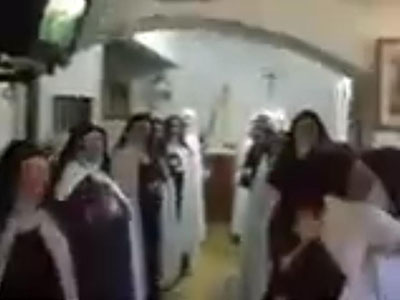
Perhaps a short video clip will help illustrate this point to our readers. The clip to the right is an example of the kind of community that Saint Teresa of the Andes might have entered. As you can see in this video, despite its poor resolution, despite being unknown and without a website, the love that pervades this community is very evident. For a community to celebrate the entrance of a young aspirant with joy, points to a great love that its members share among themselves. It should go without saying, sometimes the best communities are not always the most popular or well-known. Indeed, paradise does exist on this earth in holy communities. And if one finds such a community, they have found a "pearl of great price."
Saint Catherine of Siena: "The soul cannot live without love. She always wants to love something because love is the stuff she is made of, and through love I have created her."
Saint Alphonsus De Ligouri: "Find me, if you can...a soul more happy or content than a religious divested of every worldly affection, and intent only on pleasing God." [...] Regarding "melancholic" religious: By appearing sad and afflicted she dishonors religion, and gives all who behold her to understand that sanctity, instead of infusing peace and joy, fills the soul with sorrow and melancholy. But by a cheerful countenance she encourages others to the practice of piety."
Saint Catherine of Siena: "They are not scandalized by any grumbling on anyone's part...They are always peaceful and calm...In everything they find joy and the fragrance of the rose. This is true not only of good things; even when they see something that is clearly sinful, they do not pass judgment, but rather feel a holy and genuine compassion, praying for the sinner and saying with perfect humility, 'Today it is your turn; tomorrow it will be mine unless divine grace holds me up.' [...] They are never scandalized in those they love, nor in any person, because in this regard they are blind, and therefore they assume no right to be concerned with the intentions of other people, but only with discerning my merciful will."
....more quotes
Saint Alphonsus De Ligouri: "The faults committed after profession by a good religious are expiated in this world by her daily exercises of piety, by her meditations, Communions, and mortifications. But if a religious should not make full atonement in this life for all her sins, her purgatory will not be of long duration. The many sacrifices of the Mass which are offered for her after death, and the prayers of the community, will soon release her from her suffering." We see then necessity of finding a community that will support and love one another in this way, especially through prayer. A soul that truly loves will continue to pray for her companions even after they have passed away, assisting their souls through purgatory and that much quicker to the throne of God, where they will in turn become powerful intercessors for their companions still living on earth.
Mother Teresa: "Spread love everywhere you go. Let no one ever come to you without leaving happier. [...] The miracle is not that we do this work, but that we are happy to do it. [...] True holiness consists in doing God's will with a smile."
4. Do They Live and Eat Simply, and Practice Mortification?
Religious life, says Saint Francis De Sales, is a "school of mortification". By design, it is meant to stretch and develop souls beyond their natural capacities---to break attachments, die to self-will, and grow ever more quickly in love. As Saint John of the Cross writes, "Understand that you have come to the monastery so that all may fashion you and try you." He adds, " you should think that all in the community are artisans...present there in order to prove you." The most important kinds of mortifications are interior, such as; not imposing one's opinion, seeking to go unnoticed, not defending oneself when accused, never complaining or murmuring, being punctual at the bell, being obedient and docile in all things, and the like. These kinds of mortifications are what gives religious life its beauty. As gold is purified by fire, so love is purified in the fire of sacrifice, trial, and mortification. In her letters, Saint Teresa of the Andes writes; "How happy I feel when I can tell Him at the end of the day that I denied myself in everything." These interior kinds of mortifications, although superior, are difficult to obserive exteriorly if one is just visiting a community. Thus, we will speak of the exterior kind next.
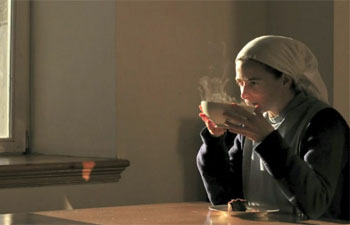
Community of Jerusalem, CanadaExterior moritifications are also an important component of the spiritual life, and can be helpful in the subjugation of the flesh, even though they are of lesser importance to those mentioned above. (link) Among the corporal penances that one can practice, fasting considered the "chief" penance by the Church, and is given primacy of place above all other penances (link). Fasting should therefore be the preferred penance by most. It is a great tragedy today that so few religious fast with any degree of rigor anymore. While it is true that Vatican II relaxed the norms on fasting, religious are expected to fast beyond the minimum required for the ordinary faithful (the traditional custom of bread and water on Friday, for example, is still quite fitting for religious). Great attention should also be paid to what is served at table (link). Restraint at table should be the norm. But we must urge caution on one account: Mortifications should never be done for their own sake; for then it will become a means to flatter oneself and inflame pride. The only possible way to merit graces through mortification, is if it is done for love of souls and holy hatred of oneself. Put simply, a prideful person is unable to merit any graces from heaven; for "God resists the proud, but gives grace to the humble." (James 4:6) Only the humble are capable moving heaven and influencing the course of the world. In their hands, penance, self-denial, and difficulties become wonderful tools to obtain graces and help lighten the spirit to love freely. The number of souls a good religious can save by simply loving and sacrificing is almost unquantifiable---more so than preaching or even working miracles (diary, 1767). But again we must repeat, the only way this is possible is if mortifications are done with proper intention, that is, with love (and especially humility, which is a component of love). Just as love without mortification is false love, so too is mortification without love also a counterfeit.
Saint Teresa of Avila: "Our human nature often asks for more than what it needs, and sometimes the devil helps so as to cause fear about the practice of penance and fasting...My health has been much better since I have ceased to look after my ease and comforts."
Saint Faustina: "By prayer and mortification, we will make our way to the most uncivilized countries, paving the way for the missionaries. We will bear in mind that a soldier on the front line cannot hold out long without support from the rear forces that do not actually take part in the fighting but provide for all his needs. "
....more quotes
Saint John of the Cross:"...you have not come to the monastery for any other reason than to be worked and tried in virtue.You are like a stone that must be chiseled and fashioned before being set in the building. Thus you should understand that those who are in the monastery are craftsmen placed there by God to mortify you by working and chiseling at you."
Saint Catherine of Siena: "For virtue can be proved only by its opposite. Sensuality is the opposite of the spirit, so it is through sensuality that the soul proves the love she has for me, her Creator. When does she prove it? When she mounts hatred and contempt against it."
Saint Faustina: "Once when I was suffering greatly, I left my work and escaped to Jesus and asked Him to give me His strength. After a very short prayer I returned to my work filled with enthusiasm and joy. Then, one of the sisters said to me, 'You must have many consolations today, Sister; you look so radiant. Surely, God is giving you no suffering, but only consolations.' 'You are greatly mistaken, Sister,' I answered, 'for it is precisely when I suffer much that my joy is greater; and when I suffer less, my joy also is less.'
5.
How Do They Treat The Sick and Infirm Among Them?
Just like in the world, where the best families are the ones sleeping at the bedside of their sick relative, so too should the love of religious shine for their sick members. Saint Faustina once said; "In order to know whether the love of God flourishes in a convent, one must ask how they treat the sick, the disabled, and the infirm who are there." Saint Alphonsus Ligouri makes almost the exact same statement, quoting Father Anthony torres, "If you wish to know whether the spirit of God reigns in a community, ask how the sick are treated." Alphonsus adds that although this superior was very kind and friendly toward all, he had no tolerance for lack of charity or negligence toward the sick; he "punished with severity the person who had the care of the sick whenever he was lacking in charity toward them." After giving a tour of his massive new publishing facility, Saint Maximilian Kolbe led his guests to the infirmary (where the sick are held) and told them; "Here is where the real work of God is carried out!"
Indeed, a good religious will see the sick as the soldiers on the front-lines, who protect the inner ranks from harms way. They will therefore be very tender and solitious with the suffering, realizing that suffering demands great reverence and respect for the graces it obtains. And much sensitivity is required for poor souls in such a weakened condition, who are expiating and obtaining mercy for you and for the world. Saint Faustina even went so far as to suggest that it is a desirable thing to have sick members in a community, "A soul who suffers with submission to the will of God, draws down more blessings on the whole convent than all the working sisters. Poor indeed is a convent where there are no sick sisters. God often grants many and great graces out of regard for the souls who are suffering, and He withholds many punishments solely because of the suffering souls." This statement is really quite astounding, and is worth many hours of meditation. One could say there is a "vocation within the vocation," as some are called to be burning embers for their community offering continual insense to God. It is a difficult concept to grasp in our modern society, which flees from even a toothache. If this author did not see it with his own eyes, he would have trouble grasping it as well. But there is something beautiful in a community with sick members. People seem more generous; kindness comes more easily; peace and joy seem to fill the atmosphere.
6. Do They Observe Their Rule And Constitutions?
The rule and constitutions should be the breath of life in a community; it should govern and inspirit everything they do. According to the saints, the faithful observance of the rule and constitutions is another sign of a holy community. Saint Teresa of Avila once told her nuns that if they faithfully observed the constitutions, there would be no further evidence required for their canonization. This is yet another reason why Saint Teresa of the Andes preferred one convent over the other, praising the nuns because they were "very observant of their Rule. The spirit of Saint Teresa is very evident among them." Saint Alphonsus tells us; "Yes, every religious who gives bad example by inattention to the Rule does an injury to her own soul and to her fervent companions." The saint went on to admonish the elder members of communities, noting that it is through them that laxity often enters; "Generally speaking, all the irregularities that creep into convents are to be ascribed not so much to the young, as to the advanced religious, who by their bad example lead the others to seek a relaxation of the rigor of the Rule." Time, it would seem, is a double-edged sword; those who use it well benefit; those who use it poorly regress. As the book of Revelation exhorts us to "return to your first fervor!" Time is the ultimate test for all religious orders, as small concessions in the beginning will lead to larger ones after many years. Saint Teresa of Avila was so keenly aware of this in her day--having witnessed widespread laxity in her order (which caused her to reform it)---that she often compared it to the smoke of Satan, saying it is "tiny cracks in the walls through which the smoke of Satan enters." And these cracks, according to the saint, are precisely caused by relaxations in the rule. The graces that God wants to poor out upon religious is unimaginable. But it is dependent on them living their triple vow of poverty, chastity, and obedience---not the least of which is obedience to their rule. Failure in this will forfeit these graces, and by their indifference, make community life empty and unbearable.
Saint Faustina: "On one occasion, Jesus gave me to know how pleasing to Him is the soul that faithfully keeps the rule. A soul will receive a greater reward for observing the rule than for penances and great mortifications. The latter will be rewarded also if they are undertaken over and above the rule, but they will not surpass the rule. [...] Although all the rules are important, I put this one in first place, and it is silence."
Blessed Michael Sopocko: "There are three degrees in the accomplishment of God's will: in the first, the soul carries out all rules and statutes pertaining to external observance; in the second degree, the soul accepts interior inspirations and carries them out faithfully; in the third degree, the soul, abandoned to the will of God, allows Him to dispose of it freely, and God does with it as He pleases, and it is a docile tool in His hands."
Saint Teresa of Avila: "Let them beware, for the devil through very small things drills holes through which very large things enter. May it not happen that those who are to come say; 'These things are not important; don't go to extremes'. Oh, my daughters, everything that helps us advance is important!"
7. Is Prayer Given First Place? Is Work or Conversation Over-Emphasized?
It is important that we remind ourselves that prayer is the foundation of religious life. Without prayer, nothing else a religious does will bear any fruit. It is the very heart and soul of a community, since it is how the soul unites with God and is filled with graces to be poured out to others. It is therefore of great importance to keep prayer in its proper place; for there are many dangers---even within the cloister---that can vie for ones attention and pull souls away from prayer. Among these dangers, perhaps the two most common are 1) an inordinate emphasis on work, and 2) an inordinate emphasis on conversation. Both of these can be quite subtle in how they suffocate the spirit of prayer in a community. A community may think they are satisfying their obligation to prayer when they meet together to pray the Divine Office. Yes, they are satisfying their external obligation. But more than words of the mouth, careful attention must be paid to the interior, whether they may be dissipated or distracted from true prayer of the heart. As Saint Teresa once advised a group of novice masters; "stress the interior life more than exterior things, taking daily account of how the novices are progressing in prayer." In other words, whether a novice scrubbed the dishes sufficiently, is less important than whether that same novice was dissipated in prayer that day.
We must be careful about adopting the Utilitarian mindset of over-emphasizing results, on "getting the job done." Although this mindset is common in the world and in secular corporations, it should be foreign to the religious. For example, one can cut grass with a lawnmower or with a pair of scissors. Although the lawnmower may be more efficient, the real question is not "did he get the job done," but rather, "did he obey with joy and docility." This is what matters in religious life: The interior growth of the soul, more so than productivity and efficiency. When productivity is emphasized to an inordinate degree, then prayer will suffer; the religious will be distracted, and will rush through prayer in order to return to work. Saint Faustina cautions herself in this, "I must not let myself become absorbed in the whirlwind of work, [but] take a break to look up to heaven". For this reason, saint Maximilian Kolbe would often make short visits to the chapel throughout the day, if even for a few minutes at a time.
Although this weakness tends to be more prevalent in male communities, female communities may have their own unique struggles to contend with, such as a tendency toward endless chatter, which does not edify but instead dissipates and robs its members of prayerful recollection. This was one reason, in fact, why Saint Teresa of Avila had to reform her order, due to the constant conversations and worldly banter that went on throughout the day. Such conversation is opposed to the life of a religious, which should become a continual prayer.
"Pray without ceasing" the Scriptures tell us. This, in large part, is how religious life originated. As Saint Alphonsus reminds us, "To fulfill the obligations of her state, a religious should keep her soul continually united with God." Ceaseless prayer, in other words, fulfills her state in life. But once again, we must offer a word of caution. The primacy of prayer is superseded only by two things, 1) obedience and 2) charity toward neighbor. To remain in prayer when a neighbor is in need or obedience calls us elsewhere would not only be displeasing to God, but would forfeit any graces one would have received. As Saint Catherine of Siena says, "You must never turn back for anything at all. You must not break away from holy prayer for any reason except obedience or charity." Interestingly enough, there is often a constant tension in holy souls for this very reason, of desiring to return to prayer but unable to do so. This tension, says Saint Teresa, is a good sign and can help the soul make rapid progress without them ever realizing it. It is almost as God grants the graces they would have received in prayer, knowing how deeply their hearts long for prayer but were called away through obedience or charity.
Mother Teresa: "Many people mistake the work for the vocation. The vocation is not the work. The vocation is to belong to Jesus."
Saint Teresa of the Andes; "Our life is one continuous prayer, for, even though we have but two hours of prayer each day...and even though we have to work, we remain always one with Jesus."
Saint Catherine of Siena: "Perfect prayer is achieved not with many words, but with loving desire."
Saint John of the Cross (to the nuns in one of Saint Teresa's convents): "Do not omit mental prayer for any other occupation, for it is the sustenance of your soul."
Saint Catherine of Siena: "The medicine by which [God] willed to heal the whole world and soothe His wrath and divine justice was humble, constant, holy prayer."
Saint Teresa of Avila, Constitutions: "Their earnings must not come from work requiring careful attention to fine details, but from spinning and sewing or other unrefined labor that does not so occupy the mind as to keep it from the Lord."
....more quotes
Mother Teresa: "We need to find God, and he cannot be found in noise and restlessness. God is the friend of silence. See how nature - trees, flowers, grass- grows in silence; see the stars, the moon and the sun, how they move in silence... We need silence to be able to touch souls."
Saint Francis De Sales: "Try to speak from your heart. A single Our Father said with feeling has greater value than many said quickly and hurriedly."
Cassian: "The religious prays little, who prays only when she is on her knees in the choir or in the cell."
Saint Gregory Nazianzen: "So often we should remember God as we draw breath."
8. Do They Display Holy Modesty?
Modesty is a sign of a chaste spirit, which is a component of the vow of chastity, which all religious take. Padre Pio once said that modesty is the greatest exterior sign of the interior state of a soul; "nothing more widely represents the good or bad qualities of a soul than the greater or lesser regulation of the exterior, as when one appears more or less modest." And according to Saint Alphonsus, the exterior of a religious should reflect the interior sanctity to which his vocation calls him to; "In a secular, no one observes indecent words, because they are common in the world. But if religious who profess to aspire to sanctity be guilty of the smallest impropriety, universal attention is immediately directed to their conduct". Thus, he concludes, a religious must practice modesty "not only in looks, but also in one's whole deportment, and particularly in dress, talk, conversation, and all similar actions". Modesty is considered one of the twelve fruits of the Holy Spirit, and is also one of the chief virtues practiced by the Blessed Virgin Mary. Saint Francis De Sales instructs us; "If you want to know whether a man is really wise, learned, generous or noble, see if his life is molded by humility, modesty and submission....those who cherish the angelic virtues of purity and modesty, will always speak simply, courteously, and modestly." Indeed, modesty and humility often go hand-in-hand; for when one has knowledge of self in relation to God (which is what humility is), then one cannot help but posses a certain meekness in demeanor toward all. Such modesty is important in community life; for it is the communication of one's exterior, more so than words, that can have the greatest effect on others. The modest countenance of a single member (provided they are humble) will easily edify and inspire their companions to greater holiness. Conversely, an immodest countenance can discourage, disquiet, and cause dissipation in the community. When Padre Pio was a young friar, he not only asked for the most penances and permissions to extend his prayer, but he always did so with a kind, meek, and good natured disposition (a rare combination; for those who ask for additional penances, more often than not, tend toward "melancholy," as they saints would call it). Padre Pio's superior described the young Fra Pio thus: "Like all the others who met him, he was most impressed by Fra Pio's conduct, 'Amidst the lively, noisy students, he was quiet and calm, even during recreation. He was always humble, meek, and obedient.'" (Ruffin, 55)
Saint Faustina: "I have come to understand how great an influence I have on other souls, not by any heroic deeds, as these are striking in themselves, but by small actions like a movement of the hand, a look, and many other things too numerous to mention, which have an effect on and reflect in the souls of others, as I myself have noticed. [...] One can speak a great deal without breaking silence and, on the contrary, one can speak little and be constantly breaking silence."
Padre Pio: "You must be modest; modest in speech, modest in laughter, modest in your bearing, modest in walking. All this must be practiced, not out of vanity in order to display one's self, nor out of hypocrisy in order to appear to be good to the eyes of others, but rather, for the internal virtue of modesty, which regulates the external workings of the body."
9.
Do They Possess The "Spirit" of Obedience?
The vow of obedience encompasses more than simply carrying out the orders of the superior verbatim (although this is a large part of it). It is also consists in carrying out those orders with a spirit of joy and love, and not complaining or murmuring about the superior or others. The saints would often rebuke their companions for any sort of complaining or criticizing of any of their peers, let alone the superior. In fact, Saint Alphonsus Ligouri believed that anyone unable to overcome the vice of criticism and murmuring "should be banished from all monasteries, or should at least be separated from the society of their sisters." To the saints, criticizing and murmuring is a poison in religious life and akin to the spirit of Lucifer, since it erodes the spirit of obedience in a community, and breeds cynicism over time. Saint Faustina once said "shun murmurers like the plague." And Saint Mary Magdalene de Pazzi said if she knew anyone who had never spoken ill of a neighbor, she would have him canonized. Saint Alphonsus adds, "The safest most charitable rule is to think well of all, and banish all such judgment and suspicions." The saint then clarifies that superiors are exempt from this; for their office demands they be aware of the vices in their community in order to correct them, "it is their duty to suspect whenever there are grounds of suspicion. But if by your office you are not charged with the correction of others, endeavor always to judge favorably of all your sisters."
When visiting a community, it is therefore important to pay close attention to how they speak about each other---not only the superior, but also their companions as well. A holy community will not only avoid complaining and murmuring, but will tend to speak well of their companions, and tend to overlook their faults. And if a debate happens to ensue on some topic, a holy religious will tend to acquiesce rather than impose their opinion, in order to preserve peace. As Blessed Egidius notes, " in such controversies, to submit is to conquer, because submission evinces a superiority in virtue." But perhaps the best example of the spirit of obedience is how a religious responds to a false accusation of some fault or defect of character. The human response is to defend ones reputation. However, in religious life, where virtue ought to be the rule of life, a more honorable response would be laudable. Saint Alphonsus provides an example, "When told that someone has charged you with a certain fault, let your answer be that they know you very little; that if they were aware of all your defects, they would say a great deal more against you." Yes! Now this is holiness! And if the superior denies a certain permission, pay attention to how they respond. Padre Pio was known to be constantly asking for permissions to take on certain penances or extend his prayer. But his superiors would not always comply. Yet Pio was always meek and docile in all these situations (though he did humbly state his case with all loving simplicity). This is a very clear sign of virtue, since the natural human inclination is to want our own will, even in pious practices. But to submit to the will of the superior, especially when it is a rejection, is an act of far greater merit.
Let us remember why obedience is so important. For the saints, disobedience comes from the very depths of hell, since the fall of the angels resulted in a single act of disobedience---rooted in pride---as did the fall of man. In order to redress the sin of Adam and make amends for the fall, the opposing virtue must be exercised: Humble obedience. This virtue was exemplified by Our Lord to a perfect degree, Who was "obedient unto death," and His Blessed Mother. Religious life, in fact, is designed with the vow of obedience in mind, and is the safest path toward virtue for this reason. As Saint Francis De Sales says, "our own choice and selection spoil or lessen almost all virtues." In other words, by denying our will, by giving up our own choices, we can have greater certitude of following the will of God. Promptness to the bell, saying ones prayers faithfully, working when its time to work, all this is part of obedience as well. But what truly separates an ordinary community from an extraordinary one, is if its members seek out ways to exercise obedience beyond just the barest minimum, and are consistent and persevering in this (not once, not twice, but day-in and day-out).
Saint Teresa of Avila was very fond of her nuns for this reason. She recalls once a sister approached a superior every day asking for permission for a certain mortification. Annoyed at her persistence, the superior told the young sister, "Go on, keep walking, don't bother me." With great simplicity, the nun did exactly that: She kept walking for the rest of the day and into the night, until another nun found her. For Saint Teresa, the simplicity of this nun's obedience was praiseworthy, and the carelessness of the superior was blameworthy. As she writes, "I find I am happier that they go to excess in matters of obedience, because I am particularly devoted to this virtue." On another occasion, Saint Teresa herself wanted to test the obedience of one of her nuns (who was more intelligent and known to be virtuous). And so she asked the sister to plant a rotten cucumber in the ground. The sister did not think to question the irrationality of the request, but only asked whether she should plant it upright or sideways. For Teresa, it was endearing that her nuns were so eager to be stretched in obedience. Should it be any surprise, then, that ecstatic visions and supernatural favors were so commonplace in all her convents?
10. Do They Possess The Three Marks of An Authentic Catholic?
Perhaps the most obvious and yet the most important consideration to make: Are they Catholic. The following three marks have been described by the saints as the three signs of an authentic Catholic, and are an absolute necessity for any community to be one in mind with the Church;I. Fidelity to the Pope.
One of the greatest signs of whether the spirit of obedience reigns in a community, is how they speak of the Holy Father, who, in a certain sense, is superior of all superiors---having universal authority over the whole Church (though most orders do not report directly to him unless they are of pontifical rite). As the vicar of Christ on earth, the pope's authority is supreme, even if he is contradicted by all the bishops of the world. As Lumen Gentium stated; "the Roman Pontiff, by reason of his office as Vicar of Christ, and as pastor of the entire Church has full, supreme, and universal power over the whole Church, a power which he can always exercise unhindered." The first Vatican council even anathematized any Catholic who says that the pope does not have absolute power over the Church.If one has studied Church history for any length of time, they will know just how often the Holy Spirit protects the Church through the popes. Even if some popes were not shining examples of virtue and intellectual prowess, it does not matter. They were there when it counted. It was the popes who saved the Church from falling into heresy numerous times, even when most other bishops accepted those heresies (especially those in the East). It cannot be disputed that the popes have been singularly protected by the Holy Spirit throughout history, unlike any other man on earth.
It is for this reason that criticism in a community, especially of the pope, is a manifest sign of a poorly formed faith. The saints are very clear on this point. It is not enough to just speak well of their own superior. But their obedience must extend up through the Church as well. This is not to say that one cannot disagree with certain actions or words of the current Holy Father. However, to do so publicly shows a certain level of imprudence and lack of discretion. If one wants to criticize the pope, there are many Protestant denominations and schismatic sects one can join, where they can criticize all they want, and cease making any progress on the path to perfection. But as Catholics, we do not to uncover the wounds of those in our family needlessly. There is not one saint in history who was known for criticizing the pope at table, nor during recreation, nor even from the pulpit. And if the Church persecuted the saints unjustly, they would obediently submit to their Holy Mother without question. Some may object and point to Saint Catherine of Siena, for example. But this rare example is an exception, not the rule. And what is more, she did so hidden from other people, through private letters sent directly to the pope, in an effort to compel him to return to Rome. Never once did she criticize the pope in her writings and in her public life. And yet some groups today who claim to be Catholic do nothing but criticize in their writings and public life. And this criticsm does nothing but breed a spirit of cynicism and pride in their flock. There is no humility in any of these sects, and for this reason alone it is antithetical to the religious state (indeed, pride is an impediment to religious life).
It is also helpful to consider whether the community reads any of the pope's latest encyclicals, out of respect for his office. The Apostolic Constitution on the Renewal of Religious Life stated all religious communities should "actively promote among their members an adequate knowledge...of the needs of the Church." Who better than the vicar of Christ--the one singularly protected by the Holy spirit---to know the needs of the Church? Granted, not everything a pope says should be considered law (especially in private conversation, an interview, or even public homilies). But when it comes to reading his latest Encylicals (and even his Apostolic Exhortations, which require some degree of religious assent as well), then we would do well to pay attention. Again, these documents are not infallible in themselves. But they do demand at least our deference and respect by prayerfully reading them.
II. Love of the Holy Eucharist.
The Church teaches that the Eucharist is the "source and summit of the Christian life" (CCC, 1324). The saints have said that the daily life of a religious can be divided into two parts, 1) the preparation for Holy Communion, and 2) thanksgiving after Holy Communion. It is thus that a religious lives each day, with the Eucharist as its cornerstone. When visiting a community, then, it is important to observe how Our Lord is treated in the tabernacle. Saint Maximilian Kolbe was fond of making many brief visits to the Blessed Sacrament through the day. Saint Faustina would also pause to greet Our Lord in the Blessed Sacrament. This is be a sign of prayerful hearts that are Eucharistic-centered. One might also observe the reverence, silence, and recollection displayed before the tabernacle, or whether the community has periods of meditation before the Blessed Sacrament, or daily Adoration. A holy community will be able to quickly and easily enter into a prayerful state upon entering the chapel, even following recreation. (The holier a soul is, the easier it is to enter into prayer and recollection, even amidst exterior distractions).III. Devotion to Mary.
He who loves God, also loves what God loves. And there is no being in creation more loved that His very masterpiece, the Blessed Virgin Mary. In this sense, devotion to Mary is not an option, but a necessity for all Christians. Pope John Paul II once said that Our Lady's superiority is above even Saint Peter (not in ecclesial hierarchy, but in moral hierarchy). The Church teaches that Mary is our Mother, Advocate, Mediatrix of all grace, and Co-Redemptrix. In many ways, She is the best kept secret of the saints. Saint Louis De Montfort once stated that the holiness of the saints in the end times will far surpass the holiness of the saints of old; and it will be due to the fact that Our Lady will become more known and loved. Mary is the who is able to most quickly and easily raise a soul to the heights of sanctity, formed in the image of Her Divine Son. Saint Teresa of the Andes constantly asked Our Lady to give her Her heart, saying; "With this treasure I will have everything, given that in it is Jesus and all the virtues". Saint Louis De Montfort once said; "One of the greatest reasons why the Holy Spirit does not do astounding wonders in our souls, is because He doesn't find sufficiently great union with His spouse." Saint Montfort even suggested that the demons fear Mary more than even Jesus Christ Himself. Why? Because while Jesus is God, Mary is a mere human elevated above all the angels in heaven, which wounds his pride more than anything else. Mary's status it thus a greater triumph against the pride of Lucifer. It is thus that a good community will possess a deep devotion to Our Lady, which will be evident in their daily prayers, rule, and constitutions.
SOURCES:
Davide A. Bianchini, Contact


